
- All
- Product Name
- Product Keyword
- Product Model
- Product Summary
- Product Description
- Multi Field Search

Views: 0 Author: Site Editor Publish Time: 2025-10-10 Origin: Site


Rotary actuators play a vital role in automation, machinery, and industrial systems. They convert energy into rotational motion, enabling precise control over mechanical movements. Whether powered by hydraulic, pneumatic, or electric energy, these actuators are widely used in industries like automotive, aerospace, and robotics.
In this blog post, we will explore the different types of rotary actuators, focusing on the Hydraulic Rotary Actuator, its working principles, and applications. By the end, you’ll know how to choose the right actuator for your specific needs.
A rotary actuator is a device that converts energy (typically electrical, pneumatic, or hydraulic) into angular or rotational motion. Unlike linear actuators, which move in a straight line, rotary actuators generate torque that enables the rotation of a shaft, gear, or other mechanisms. These actuators play a vital role in machinery, industrial automation, and many mechanical systems.
Rotary actuators use fluid pressure, electric power, or compressed air to move a shaft in a circular motion. This can be either continuous or limited, depending on the actuator’s design and application.
These actuators are used in a variety of systems, such as robotic arms, valve actuations, and in aerospace for controlling flight surfaces. They are crucial in situations requiring precise movement control.
There are several types of rotary actuators, each with unique characteristics suited for specific applications. These can be broadly classified into Hydraulic Rotary Actuators, Pneumatic Rotary Actuators, Electric Rotary Actuators, and Manual Rotary Actuators.
Hydraulic rotary actuators are powered by pressurized fluid (usually oil) to generate rotational motion. These actuators are known for their ability to produce high torque and handle heavy-duty applications. Due to their power, they are commonly used in construction, aerospace, and industrial equipment.
Applications:
● Heavy machinery like cranes, excavators, and bulldozers.
● Aerospace systems, where high precision and force are critical.
● Industrial applications requiring significant torque, such as steel manufacturing.
Benefits:
● High Torque Generation: Hydraulic actuators generate significant torque while maintaining compact sizes.
● Efficiency in Heavy-Duty Applications: Ideal for machines that require high power for operation.
Subcategories:
● Piston-Based Hydraulic Actuators: These actuators use a piston moving inside a cylinder to generate rotational motion.
● Vane-Type Hydraulic Actuators: These actuators use rotating vanes inside a cylinder to produce angular motion.
● Diaphragm-Type Hydraulic Actuators: Flexible diaphragms move under fluid pressure to create motion.
Pneumatic rotary actuators convert compressed air into rotational motion. These actuators are ideal for applications requiring moderate force and speed, such as valve control, robotic arms, and material handling systems.
Applications:
● Robotics in industrial automation.
● Valve control systems in various industries like food processing and pharmaceuticals.
Benefits:
● Cost-Effective: Relatively cheaper and simpler than hydraulic actuators.
● Quick Response Time: Fast actuation, making them suitable for applications requiring rapid movement.
Subcategories:
● Rack and Pinion Actuators: Use a linear gear (rack) and a rotating gear (pinion) to convert linear motion into rotation.
● Vane-Type Pneumatic Actuators: A vane is moved by air pressure to generate rotation.
● Scotch Yoke Pneumatic Actuators: Utilize a piston moving along a track to rotate a shaft.
Electric rotary actuators use electric motors to generate rotational motion. These actuators provide high precision and control, making them ideal for applications that demand exact positioning and motion control.
Applications:
● CNC machines and other automated industrial systems.
● Robotics in manufacturing and assembly lines.
Benefits:
● High Precision: Electric actuators offer accurate and repeatable positioning.
● Easy Integration: They can be integrated into digital control systems, making them suitable for modern automation setups.
Subcategories:
● Servo Motors: Highly precise electric motors, ideal for applications requiring constant feedback on speed and position.
● Stepper Motors: Used in systems that require precise step-based rotation, such as in 3D printing and robotic systems.
Manual rotary actuators are operated by hand, typically using a gear or wheel to turn a shaft or valve. These actuators are often used in applications where electricity or hydraulic power is not available.
Applications:
● Used in situations like valve control, especially in smaller-scale systems or as manual overrides in industrial equipment.
Benefits:
● Cost-Effective: These actuators are relatively inexpensive and require no external power source.
● Simplicity: Manual rotary actuators are simple to design and use, often providing a reliable backup or emergency option.
Subcategories:
● Worm Gear Actuators: These actuators use a screw and wheel mechanism to provide torque to a load.
● Hand-Wheel Actuators: Use a large wheel to operate the actuator by hand.
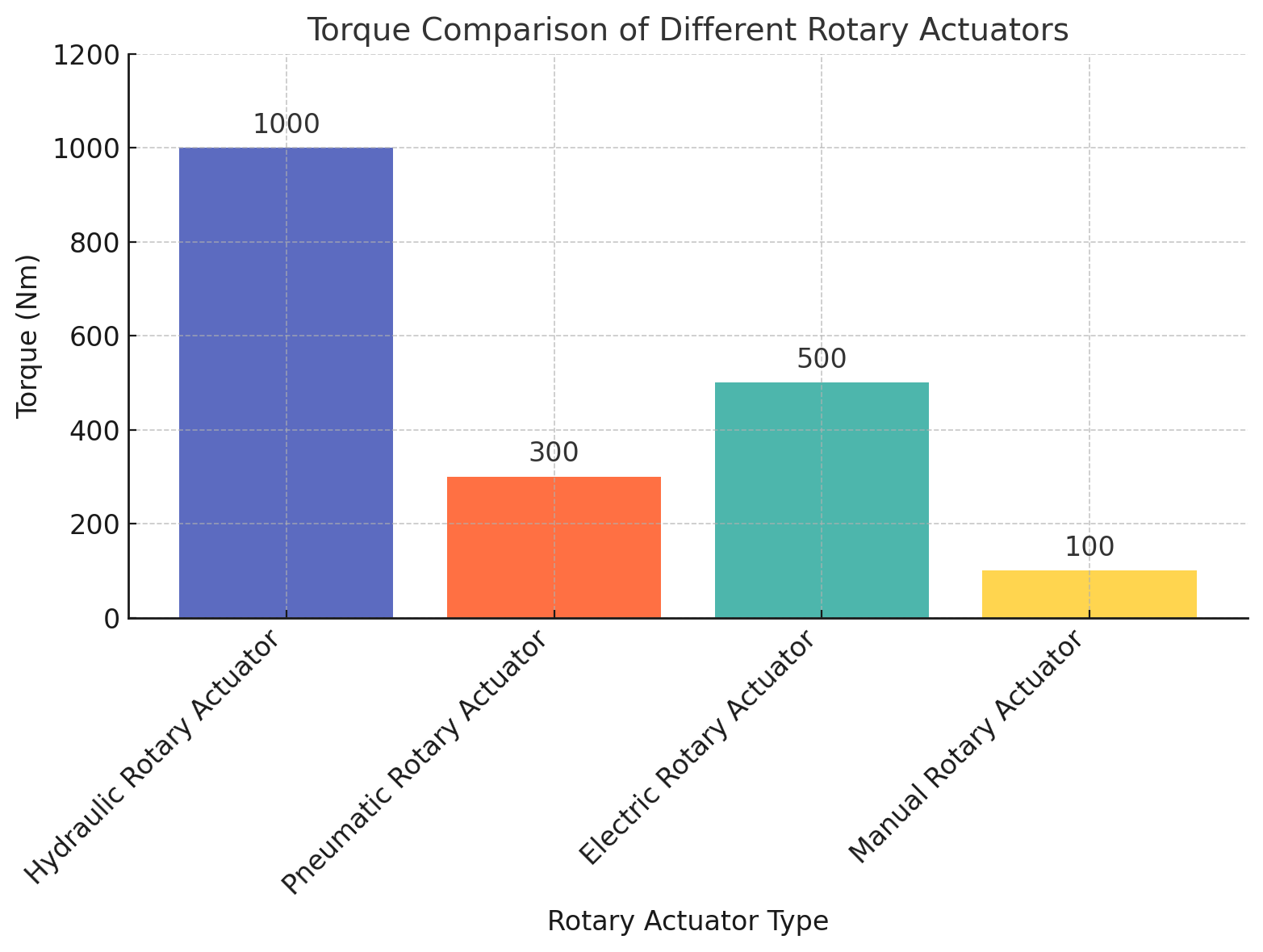
Choosing the right rotary actuator depends on several key factors:
Select an actuator with the appropriate torque output for your application. A Hydraulic Rotary Actuator is ideal for high-torque, heavy-duty tasks, while electric and pneumatic actuators are better suited for lighter tasks.
If your application requires precise control over speed and position, consider electric actuators like servo motors or stepper motors. For moderate speed, pneumatic actuators might be more cost-effective.
Consider the environmental conditions where the actuator will be used. For outdoor applications or environments with extreme conditions, ensure that the actuator is resistant to weather elements, dust, and moisture.
Rotary actuators are used in a wide variety of industries, thanks to their versatility. Here are some key applications:
In manufacturing, Hydraulic Rotary Actuators and electric actuators are used to control machinery, robotic arms, and production lines. They ensure precise and repetitive movements, improving operational efficiency.
In aerospace systems, rotary actuators control aircraft flaps, rudders, and other critical components that require reliable, high-force rotation.
Electric rotary actuators are used in automotive systems such as power steering, transmission systems, and brake controls. These actuators provide precise control for smooth vehicle operations.
Rotary actuators are used in medical machinery such as MRI machines and surgical robots. Their precise control allows for accurate positioning of medical equipment.
Rotary actuators provide numerous benefits across various industries:
These actuators deliver high-precision movements, making them ideal for applications requiring accurate positioning, such as CNC machines and robotics.
Rotary actuators come in various types (electric, pneumatic, hydraulic), offering flexibility to suit different application needs, from heavy-duty to light industrial uses.
Especially Hydraulic Rotary Actuators, which provide the high force necessary for heavy-duty applications, can efficiently manage large loads with compact designs.
While rotary actuators are highly beneficial, they also have limitations:
Hydraulic Rotary Actuators tend to be more expensive compared to pneumatic or manual versions, especially when high performance and precision are required.
Pneumatic and electric actuators can generate significant noise during operation, which can be problematic in quiet environments.
Regular maintenance is essential for ensuring the longevity and performance of rotary actuators, particularly for hydraulic actuators which require fluid checks.
In conclusion, rotary actuators are versatile devices that convert various forms of energy into rotational motion. Whether powered by hydraulic, pneumatic, or electric energy, each type of rotary actuator has unique features suited to different applications. For heavy-duty tasks, Hydraulic Rotary Actuators are often the best choice due to their ability to generate high torque. When selecting a rotary actuator, consider factors like torque, speed, precision, and environmental conditions to ensure the actuator meets the specific needs of your application.
For more information or assistance in selecting the best actuator for your system, feel free to contact us today! Hydraulic Rotary Actuator, Helac Rotary Actuator Manufacturer & Supplier - Chiyu Hydraulics offers high-quality rotary actuators designed to provide optimal performance across various industries.
A: A Hydraulic Rotary Actuator uses pressurized fluid, typically oil, to generate rotational motion. It produces high torque, making it ideal for heavy-duty applications like construction and aerospace.
A: Choose a Hydraulic Rotary Actuator for applications requiring high force and torque, especially in industries like construction and manufacturing where heavy machinery is involved.
A: Hydraulic Rotary Actuators provide high torque in compact designs, ensuring efficient operation in heavy-duty tasks. They also offer precision and reliability in various industrial applications.
A: Hydraulic Rotary Actuators are used in heavy machinery, robotics, aerospace, and construction, where high torque and precision are crucial for optimal performance.
A: Yes, Hydraulic Rotary Actuators tend to be more expensive than pneumatic or electric actuators due to their advanced design and high torque capabilities required for heavy-duty tasks.


